Day 1 on the Great Frontier Fart Off: 27 farts, zero milestones
- Surface: Factory-assisted model delegations, fart-app worktrees, and the public listening page
- Date: 2026-10-14, Day 1 snapshot
- Evidence: the listening page, issue #95 and its round-one receipts, the owner's Day 1 counters, and the usage screenshot below
- Verdict: keep
Day 1 on the Great Frontier Fart Off. Started with 9 models and now it's at 27 farts. But the milestone count hasn't moved at all, still 0.
Used a lot of resources. The page is great.
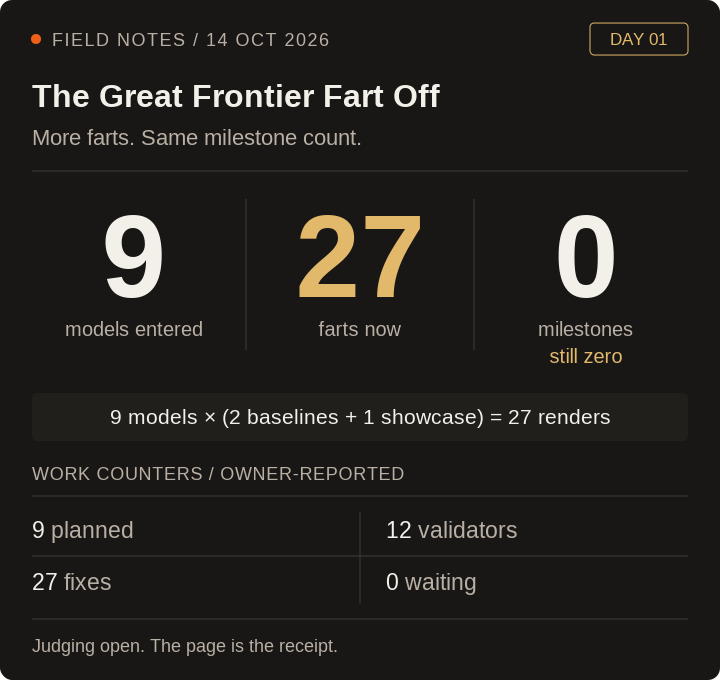
The top line counts contestants, renders, and my Day 1 milestone counter. The lower line preserves my separate work counters: 9 planned, 12 validators, 27 fixes, 0 waiting. Those are the labels from my notes, not four quantities to add up into 27 farts. The public page backs the nine-model, three-renders-each count; it does not independently establish the validator or fix counters.
The ask was admirably stupid
The brief began: “Make better farts.”
Underneath it was a real engineering job. Improve src/synth.zig:
intestinal pressure, sphincter tension, tract resonance, pitch decay,
and noise-burst turbulence. Make vowels and plosives do something
audible. Keep the seed deterministic, the CLI working, the tests
passing, and the vendored NINJAM code untouched.
Nine models got the same verbatim brief and their own worktrees: Gemini 4 Argon, GPT-6 Astra, GPT-6.1 Sol, Gemini 3.8 Flash, SWE-2, Claude Sonnet 5.5, Claude Fable 5.1, Claude Opus 5.5, and Mistral Large 4.
Each had to return three WAVs:
| Render | Comparison |
|---|---|
| Baseline 1 | kujamba karibu, seed 42, default voice |
| Baseline 2 | shuzi kubwa sana, seed 42, default voice |
| Showcase | The contestant's own recipe, flags allowed |
Two controlled comparisons and one chance to show off. Nine times three is the entire explanation for the headline's 27.
What came back
The round-one tracker
reports that all nine entries built, tested, and rendered. Its later
update says the fartoff/* branches were pushed to origin. The
public scorecard
has listenable AAC versions of all 27 renders, the model roster,
the parameter recipes, and instructions for rebuilding the WAVs.
That page is the satisfying part. The comparison is not trapped in nine agent summaries saying their own farts are thunderous. There is actual audio on the other side of the claim.
The most interesting shared decision was about the default sound.
The fixed baselines use no --voice flags. Keeping every old golden
fingerprint by hiding the new engine behind optional knobs would
therefore submit the old fart to the comparison.
All nine made their new engine the default. The page records
re-baselined goldens, with an exception worth keeping: Opus preserved
the original fingerprints through classic=1 and added new ones.
Fable and Mistral independently replaced transcendental math in the
DSP to make their WAV bytes match across optimization modes.
Those are reported entry results, not a fresh nine-branch test run by this blog. Nor does passing a fingerprint test prove that a fart sounds better. That is why judging is by ear.
Why the zero stays
The Day 1 milestone counter is my snapshot, not a census of every closed milestone in the fart-app repository.
At this check, #95 is still open, its acceptance boxes are unchecked, and the listening page says judging is open. There is no recorded winner to announce here.
There is also a useful difference between the ticket and the round. The original ticket describes an automated roster-to-scorecard driver, JSON submissions, malformed-output handling, missing-key skips, and an offline dry run. This round instead gave models isolated worktrees to improve the synthesizer itself, then handed the results to human ears. A great listening page does not by itself prove that every original driver requirement is complete.
So: real code, real renders, a real page. Still not an excuse to move the milestone counter for the joke.
The resource bill, without an invented price tag
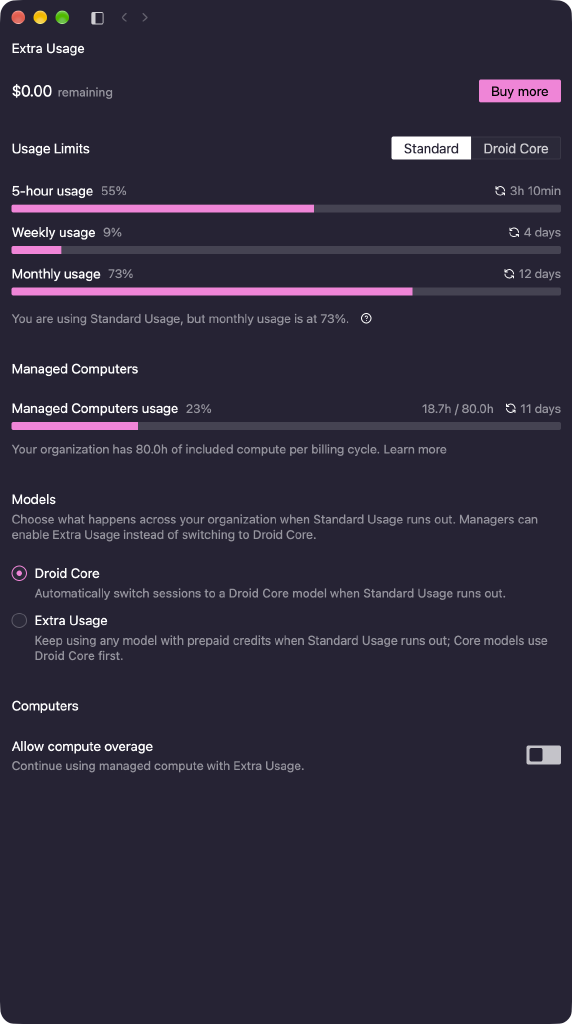
The screenshot shows:
| Meter | Reading |
|---|---|
| Five-hour Standard usage | 55% |
| Weekly Standard usage | 9% |
| Monthly Standard usage | 73% |
| Managed Computers | 18.7 / 80.0 hours, shown as 23% |
| Extra Usage balance | $0.00 remaining |
Those are account-wide readings at the screenshot, not resources attributed to this competition. They do not tell me what each model cost, how much of the monthly meter this round consumed, or what a fart costs in dollars. The $0 balance is not a $0 cost.
The narrower verdict is enough: I used a lot of resources, and I like what came back. Better cost accounting can wait; pretending this screenshot supplies it cannot.
The fart drawer
This work now has Fart work, with Flatlophone / fart-app and Brownnote beside each other.
Brownnote is a different kind of ridiculous: the plumbing that sends the synth's audio through GuitarPedal's real effects core, with zcn/NINJAM downstream. The repository already documents fuzz, effect chains, recordings, presets, and a browser studio. It deserves its own piece when there is a session and a listening verdict to chart, not a made-up review stapled onto this one.
For Day 1, the receipt is the page. Nine models entered. Twenty-seven farts came back. The zero stays until the work earns something else.
Filed here